
October 17, 2026
How changing technology affects jobs, skills, and workforce policy
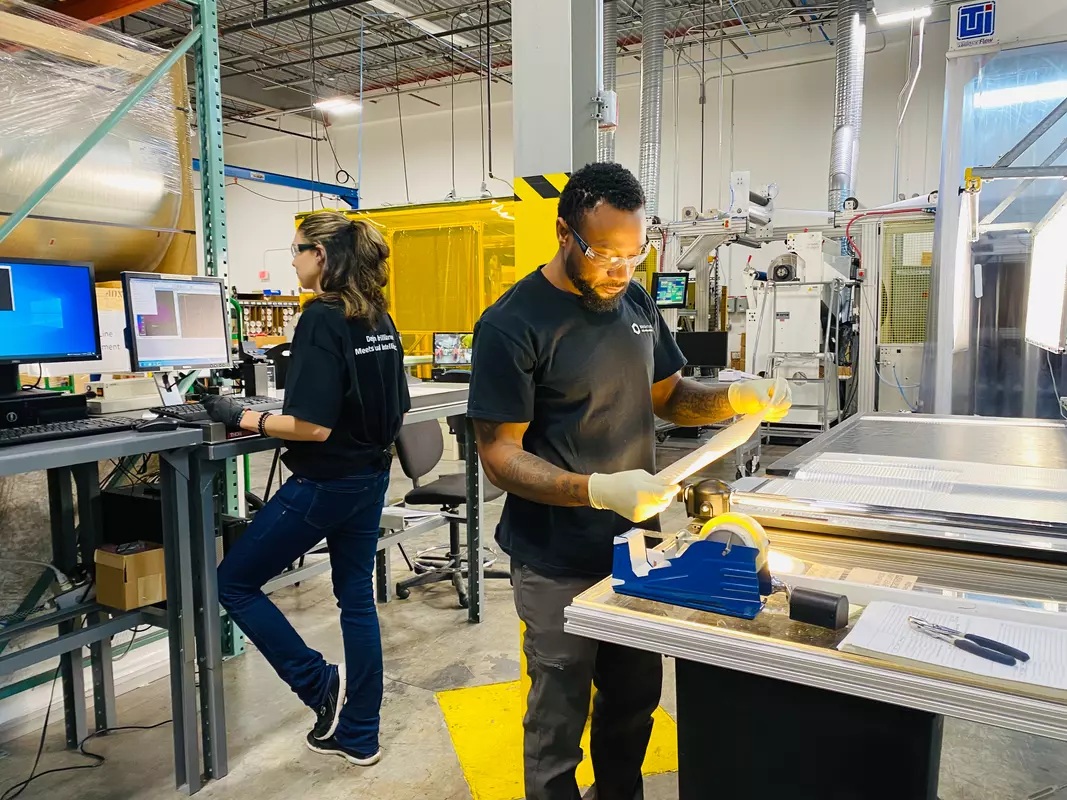
Manufacturing workers using production equipment and computer controls. Photo: NIST MEP.
AI can help a dispatcher resolve an exception, a technician find a fault, or a software team deliver a better product. It can also remove the routine assignments through which people learn, move errors into a less visible part of an operation, or put more work on employees without improving their pay.
For employers and policymakers, the immediate challenge is to improve performance while widening access to the skills, earnings, and opportunities that technology can support. How organizations redesign work—and how public policy supports that transition—will help determine who benefits.
The strongest evidence supports a measured approach: test actual results, protect routes into skilled work, and prepare for displacement without treating every exposed task as a lost job. The goal should be better outcomes for a broad majority of workers, with policies judged by results.
What the evidence tells us
The ILO–NASK 2025 index places 25% of global employment, and 34% in high-income countries, in occupations with some generative AI exposure. Clerical work is most exposed. These estimates describe potential changes to tasks, not forecast job losses. [1]
Adoption varies by industry. Census reported AI use by 19.8% of U.S. businesses and 39.7% in the broad Information sector for the period ending May 3, 2026. The measure covers any business function during the preceding two weeks; it is neither an October snapshot nor the percentage of workers using AI. [2]
Yale’s Budget Lab tracker, updated October 14, 2026, did not yet identify a clear AI-related labor-market footprint in its aggregate analyses. That does not rule out effects concentrated in particular groups. [3]
Stanford researchers found that, by June 2026, employment of workers ages 22–25 in highly AI-exposed occupations was about 19% below where it would have been had it kept pace with less-exposed peers of similar age. Weaker hiring appeared to drive much of the gap. This descriptive ADP-panel finding is not a 19% unemployment rate or proof that AI caused the difference. Its sample and methods differ from Yale’s national analyses. [4]
In a peer-reviewed study of 5,172 customer-support agents, AI assistance increased issues resolved per hour by 15% on average, with larger gains among less experienced and lower-skill workers. A March 2026 Danish working-paper revision found task reorganization but no significant average effects on recorded hours or earnings. Results from a particular deployment or country should not become a universal forecast. [5, 6]
Software evidence also requires context. METR found a slowdown among experienced developers using early-2025 tools; its 2026 follow-up could not reliably estimate current gains because of selection and measurement problems. A later survey reported perceived benefits, but relied on a convenience sample and self-reports. Employers should measure accepted work in their own setting as tools change. [7]
Start with the work and its consequences
Most of this evidence concerns generative AI: systems that produce or analyze text, code, images, and related content. Robotics, machine vision, scheduling algorithms, and autonomous vehicles create different operational and workforce questions. A forecast about language-model exposure cannot establish how soon a truck, warehouse, or production line can operate autonomously.
For each proposed use, identify the task, the worker who performs it, the decision it informs, and the consequence of an error. Then measure the complete workflow. A faster draft has limited value if a supervisor spends the saved time checking it or a customer later pays for a mistake.
Track total staff time, including review and rework; accepted output; service or safety failures; training time; and operating cost after software and integration expenses. Record what happens to the time released: more capacity, better service, reduced overtime, development of new skills, or fewer positions. Each has a different workforce consequence.
Assess operating performance and workforce outcomes together. The measures below provide a starting point; set thresholds to match the work and its risks.
| Operational result | Workforce result |
|---|---|
| Accepted output per total staff hour | Paid time to practice and learn |
| Corrections and service failures | Workload and realistic schedules |
| Full cost per accepted outcome | Earnings and progression |
| Service during tool outages | Independent competence and coverage |
Decide how the gains will be used
After verifying a productivity gain, leadership should decide what it is for. Released capacity can support higher pay, better schedules, progression, lower customer costs, or additional business. It may also fund integration and training or restore a necessary operating margin. The allocation will depend on demand, competition, costs, and the organization’s financial position; worker benefits need an explicit place in that decision.
Set out the intended use before expanding a pilot and check the result afterward. Reduced overtime, for example, may ease fatigue but also lower take-home pay for workers who depend on those hours. Discuss that consequence and assess total earnings alongside workload. For a nonprofit, additional service capacity should be assessed against staff workload and the quality of constituent service.
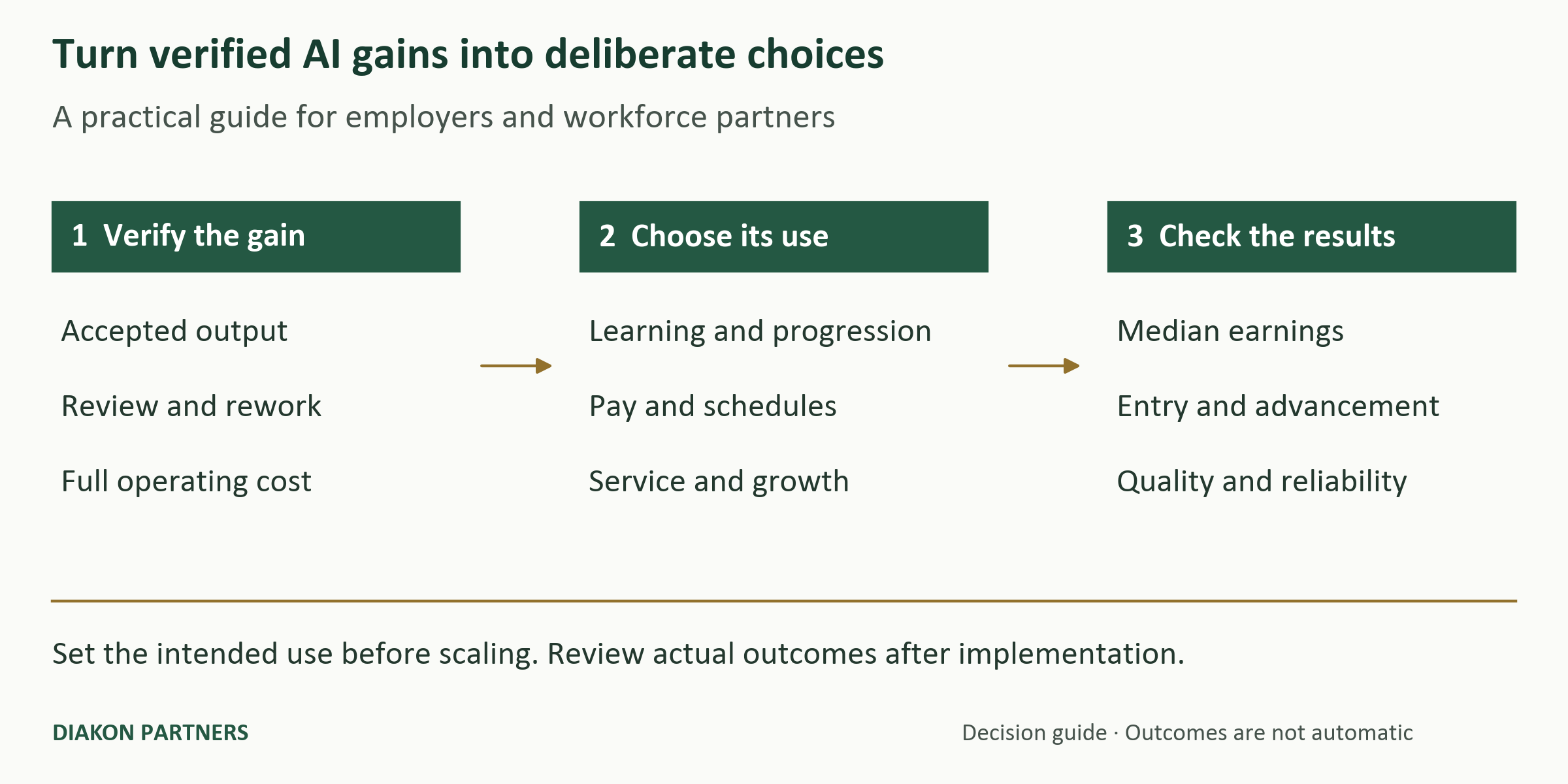
A decision guide, not a forecast: verify the gain, choose its use, and measure operating and worker results together.
Where client decisions become practical
Technology companies. Evaluate AI-assisted development through accepted, secure releases, defect rates, review workload, and customer outcomes. Keep supervised assignments through which junior developers learn debugging, architecture, and accountability. Product teams should make limitations, data controls, and the customer’s review responsibilities clear. A tool that accelerates code generation can still increase the burden on testing and security teams.
Air cargo, forwarding, logistics, and final-mile delivery. Test document extraction, customer communications, and exception triage against actual shipment records. Keep responsibility clear for shipment instructions, customs information, security decisions, and release authority. Train operations staff to recognize missing evidence and escalate unusual cases. Measure downstream corrections and service failures alongside handling time.
Fleet management and transportation. Separate administrative assistance from decisions affecting dispatch, maintenance, driver evaluation, and safety. Verify source records and preserve a practical way to challenge inaccurate scores or schedules. Involve drivers, dispatchers, and technicians in testing. A system that improves utilization while leaving less time for inspections or recovery may create a different cost elsewhere.
Manufacturing, chemicals, plastics, and building products. Evaluate AI in technical documentation, quality analysis, maintenance support, and purchasing against controlled records and actual operating conditions. Preserve qualified approval for changes affecting product specifications or process safety. Provide training across shifts and job levels, including production employees who may have limited access to desk-based learning.
Energy, infrastructure, and construction. Connect AI-assisted planning with field conditions, engineering review, contractor coordination, and the availability of skilled trades. Test whether a planning improvement reduces site delays or merely produces more revisions. Digital tools do not remove the need to develop the people who build, operate, and maintain physical assets.
Associations and nonprofits. Use AI to support research, member or constituent service, and routine administration while protecting confidential information and checking eligibility or advice before acting. Smaller organizations may gain capacity but still lack training and review resources. Associations can aggregate member evidence about changing tasks, hiring, and training needs without presenting one employer’s experience as an industry-wide result.
Teach the skills people need on the job
Training should prepare a worker to check an answer against source records, recognize missing or unreliable information, handle exceptions, protect sensitive data, and know when to escalate. A dispatcher might verify a suggested recovery route against actual capacity; a developer might identify a security flaw in generated code; a production employee might check advice against an approved procedure. Assess those abilities through supervised work and practical demonstrations, with refreshers when tools or responsibilities change.
Worker development also has a business case. Cross-training and mentoring can strengthen coverage, succession, and service reliability while reducing dependence on a few experienced people. Compare the cost of paid learning and supervision with overtime, rework, turnover, and the loss of operational knowledge. Test whether those benefits materialize rather than assuming that training automatically pays for itself.
Preserve the route from beginner to expert
If routine work becomes cheaper, organizations need to decide how the next generation will acquire judgment. Removing junior assignments without replacing their learning function can weaken the future supply of experienced staff. The Stanford findings make that a question to investigate now, even while causation remains unsettled.
Redesign entry-level roles around supervised problem solving: compare an AI answer with source evidence, diagnose an exception, explain a correction, and observe how a senior colleague resolves a difficult case. Protect mentoring time. Assess independent competence as well as performance with the tool, so employees can recognize failures and continue essential work during an outage.
Illustrative operational situation—not an actual client engagement. A forwarder pilots AI-assisted document preparation. Managers initially see faster completion. They then compare total handling time, correction rates, shipment exceptions, and the supervisor’s review burden. Junior staff rotate through source-document checks and exception review. Expansion depends on reliable service and demonstrated competence. The pilot establishes whether time is actually released and how it can be used; it does not assume that faster preparation justifies a staffing reduction.
Labor Department steps worth building on
Several current Labor Department efforts move in the direction of these recommendations by connecting AI skills with real work and existing workforce institutions.
The Labor Department’s 2026 AI Literacy Framework provides a useful foundation. Its voluntary guidance supports practical, role-specific learning and recognizes that workers, employers, training providers, and workforce agencies have different needs. Employers and associations can build from that foundation by connecting training to supervised work, demonstrated competence, and measurable career outcomes. [9]
The Department’s AI in Registered Apprenticeship Innovation Portal, launched April 29, 2026, adds practical tools, industry-specific training resources, and guidance for integrating AI skills into apprenticeship programs. That is a constructive response to the need for routes into skilled work: it connects new technology with an established model of workplace learning. Employers should assess how the resources can support supervised assignments, mentoring, and progression in their own occupations. [10]
The Department’s April 2 partnership with the National Science Foundation also deserves attention. Through TechAccess: AI-Ready America, DOL committed to connecting planned coordination hubs with American Job Centers, Registered Apprenticeships, and workforce and education systems. The NSF program calls for hands-on assistance for small businesses and public-serving organizations. That design aligns with the need to reach employers and workers who have limited technical or training capacity. Announced connections should be judged by their implementation, not treated as proof that every community already has access. [11]
These are useful steps to build on. Their contribution should be tested through who participates, what skills people demonstrate, whether paid work and advancement become more accessible, and what happens to earnings and retention. The announcements and program design establish direction; they do not yet demonstrate those worker outcomes.
For an employer or association ready to act, bring a defined occupation, a short list of changing tasks, and a proposed learning plan to a local American Job Center or workforce partner. Ask which services and training partners fit, and use the apprenticeship resources to assess whether a structured program makes sense. Verify worker and employer eligibility, allowable costs, available funding, and required approvals before committing expenses. Associations can help smaller members develop a shared curriculum and mentoring approach. [12]
Policy choices that can broaden the benefits
Public policy should help workers move into more productive work, support viable employers, and respond when people lose income or opportunity. The recommendations below build on these constructive federal steps, the evidence above, and the OECD’s work on AI skills and workplace governance. [8]
Fund learning that connects to real work. Support paid training time, supervised practice, and instruction tied to an employer’s actual tasks. Make assistance usable by smaller employers, nonprofits, shift workers, and workers without four-year degrees. Include basic digital skills, accessibility, language support, and the practical costs of participation. Evaluate providers through demonstrated skills, employment retention, and earnings over time, with suitable comparisons; course completions alone do not establish success.
Keep entry routes open. Pilot paid apprenticeships and structured early-career placements in AI-exposed fields, including software, operations, customer service, and technical administration. Require a learning plan, qualified supervision, and transferable skills. Check whether supported placements add opportunities or merely subsidize hiring that would have occurred anyway. Include experienced workers changing occupations, not only recent graduates.
Make consequential workplace decisions accountable. For AI used in hiring, scheduling, evaluation, or discipline, establish understandable notice, relevant testing, accurate records, and meaningful review by a person with authority to correct an error. Involve affected employees and their representatives in testing, protect legitimate reporting of problems, and limit unnecessary monitoring. Scale documentation to the decision’s consequences and the employer’s size while preserving effective safeguards.
Help displaced workers recover earnings. Connect early notice where feasible with rapid job matching, benefits navigation, and training for verified local openings. Assess temporary earnings supplements or wage-insurance pilots against cost, reemployment quality, and the risk of subsidizing low pay. Track recovery of earnings and stable employment, rather than counting any placement as a successful transition. Support should respond to demonstrated need even when AI’s precise contribution to a job loss cannot be isolated.
Training alone cannot create a suitable opening. Transition plans should establish whether reachable jobs exist, what they pay, and whether workers can manage transportation, caregiving, and living costs while learning or searching. Combine skills support with practical help and income continuity where available. Evaluate whether a new job offers a sustainable recovery, including for workers who cannot relocate.
Spread access to productive tools and share the gains. Consider shared technical assistance and training through community colleges, sector partnerships, and associations. In public procurement and grants, test interoperability, accessibility, and switching costs so smaller organizations have workable choices. Ask employers seeking public support to explain how productivity gains will improve skills, progression, pay, schedules, or service capacity, and verify those commitments. Grants should not reward layoffs as the sole evidence of efficiency.
Measure who benefits and adjust. Track hiring, separations, earnings, hours, job quality, and training access by occupation, experience level, firm size, and geography, with privacy safeguards. Examine differences by gender, disability, and other relevant characteristics where data permit. Publish results and stop or revise weak programs. Pair wage measures with employment: stable wages among people still employed can coexist with reduced access to jobs.
Define success through higher productivity alongside stronger median earnings, credible entry routes, and advancement opportunities. Look separately at lower-paid workers and people who lose jobs, not only averages among those retained. Track outcomes at six and twelve months where feasible, comparing participants and similar nonparticipants when credible data allow.
These choices involve tradeoffs. Paid learning requires coverage and funding. Review procedures need staff and can slow decisions. Transition assistance has fiscal costs. Requirements that are too complex can deter smaller employers. Programs should test whether their benefits justify those costs and whether they reach workers with the least access to opportunity.
What leaders can do in the next ninety days
In the first 30 days, select a consequential workflow, establish its baseline, involve the people doing the work, and identify what must remain under qualified review. Operations should own service performance; HR should track skills and employment effects; finance should measure full costs; and the relevant technical, security, or compliance lead should set controls.
Over days 30–60, run a bounded pilot with paid practice time and a comparison where feasible. Record errors, total effort, employee feedback, and the effect on junior assignments. Set advance thresholds for quality and service, and pause the trial if critical controls fail.
By day 90, decide whether to expand, redesign, or stop. Explain the implications for responsibilities, staffing, and progression before implementation. Continue measuring outcomes beyond the pilot, including earnings, workload, retention, and access to new roles. Associations can use consistent member reporting to identify where public policy would remove a shared barrier.
Diakon Partners helps businesses, associations, and nonprofits connect these operating decisions with workforce policy, stakeholder engagement, and the evidence policymakers need. The starting point is the client’s work, people, and service commitments. A useful AI workforce strategy should show both how performance improves and how more people gain a credible opportunity to benefit.
Sources and evidence notes
Sources checked October 17, 2026. Data periods are identified in the article. Sector applications and policy recommendations are Diakon analysis; they are not findings of the cited studies. Working papers may change and are identified separately from peer-reviewed research.
[1] ILO and NASK. Generative AI and Jobs and accompanying findings, May 2025. Task exposure estimates; not observed job losses. Read source
[2] U.S. Census Bureau. Large Firms With at Least 20 Employees Biggest AI Users, May 26, 2026. BTOS data through May 3; question wording changed in November 2025. Read source
[3] Yale Budget Lab. Tracking the Impact of AI on the Labor Market, updated October 14, 2026. Aggregate analyses; absence of a clear footprint is not proof of no effects. Read source
[4] Brynjolfsson, Chandar, and Chen. Canaries in the Coal Mine, August 2026 working paper. ADP panel through June 2026; descriptive relative gap, not a causal estimate. Read source
[5] Brynjolfsson, Li, and Raymond. Generative AI at Work, Quarterly Journal of Economics 140(2), May 2025, pp. 889–942. Peer-reviewed study; one customer-support setting. Read source
[6] Humlum and Vestergaard. Still Waters, Rapid Currents, NBER Working Paper 33777, revised March 2026. Danish administrative data; not a U.S. economy-wide estimate. Read source
[7] METR. Developer experiment update, February 24, 2026, and technical-worker survey, May 11, 2026. The later survey is self-reported and not representative. Read source
[7a] METR survey. Measuring the Self-Reported Impact of Early-2026 AI on Technical Worker Productivity. Read source
[8] OECD. Bridging the AI Skills Gap, 2025; Algorithmic Management in the Workplace, 2025. Policy and employer-survey evidence, not proof of a guaranteed policy result. Read source
[8a] OECD workplace governance. Algorithmic Management in the Workplace, February 2025. Read source
[9] U.S. Department of Labor. AI Literacy Framework, Training and Employment Notice 07-25, February 13, 2026. Voluntary guidance for workforce and education systems. Read source
[10] U.S. Department of Labor. AI in Registered Apprenticeship Innovation Portal launch, April 29, 2026. Practical resources; not an impact evaluation. Read source
[11] U.S. Department of Labor. DOL–NSF workforce collaboration and TechAccess announcement, April 2, 2026. Announced commitments, not verified nationwide service availability. Read source
[11a] National Science Foundation. TechAccess: AI-Ready America solicitation NSF 26-508. Program design and intended support for small businesses, public-serving organizations, and workforce partners. Read source
[12] U.S. Department of Labor and CareerOneStop. American Job Centers and WIOA training resources. Services and funding eligibility must be confirmed locally. Read source